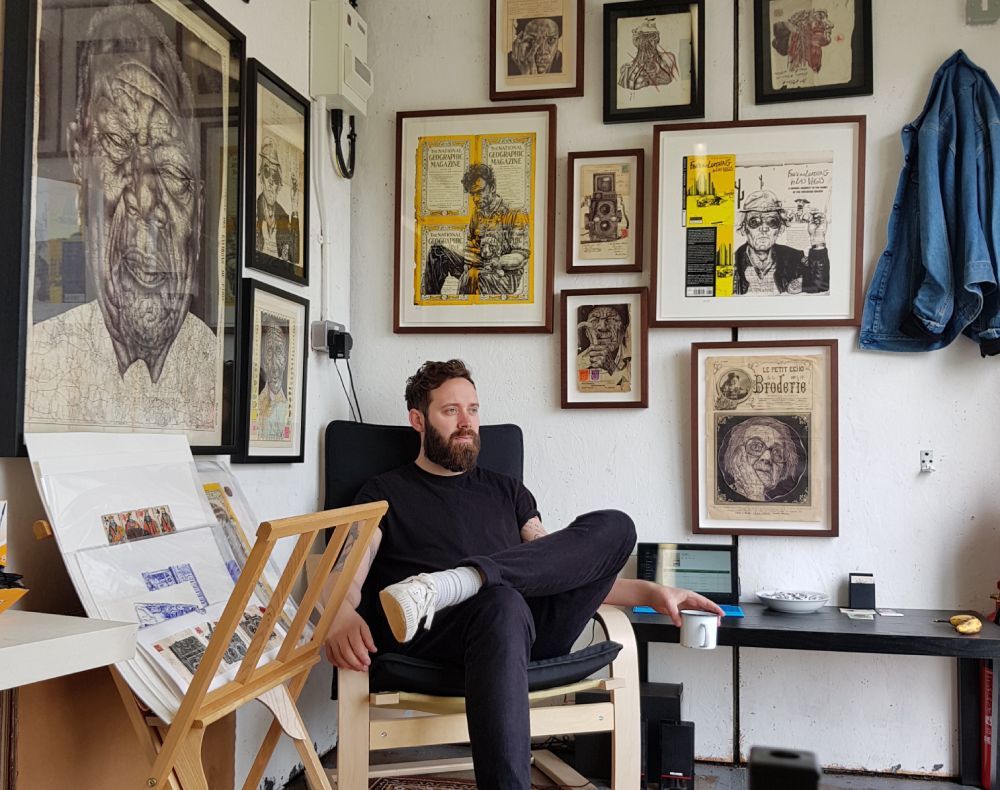

With the new body of work, French embraces modern technologies, and although each image is drawn from life and inspired by the people and events he observes, he uses his iPhone and iPad to maintain the visual diaries that form the basis of his oeuvre.
The much hyped Leonardo Da Vinci exhibition opens at the National Gallery from today with a seven room exhibition. The display is ideal for those who adore the technicality of the line and the workings of an artist , with many drawings and paintings by Leonardo and his pupils on display.
Its build up has been felt for many months, ever since its advance booking opened in May 2011 – a long seven months before its actual opening day.
With its future opening date released then came the capped visitor numbers announcement, with the gallery saying it would restrict visitors due to an, ‘unprecedented demand’. Today (9 November) The Evening Standard has reported how the tickets have sold out until mid-December. The pressure for this display to deliver to its global audience is immense.
The exhibition brings together an impressive collection of international loans never before seen in the UK, from the Queen, America, Poland, France, Scotland and from Art Fund acquisitions.
One difference with this exhibition from others is it the first to be dedicated to Leonardo’s aims and techniques as a painter. Don’t expect reams of glorious huge paintings, though there are a few pretty ladies, curly haired men and angels.
The whole display focuses on Leonardo as an artist, his technical skills and his teaching skills, showing how his works were often finished or copied by his pupils, and in some cases edited. In particular it concentrates on the work he produced as court painter to Duke Lodovico Sforza, in Milan in the late 1480s and 1490s.
As well as finished pieces, each room is peppered with Leonardo’s preparatory and experimental sketches.
The final part of the exhibition, a few mintues walk away in the Sunley Room features a near-contemporary, full-scale copy of Leonardo’s famous ‘Last Supper’, on loan from the Royal Academy. Seen alongside all the surviving preparatory drawings made by Leonardo for the ‘Last Supper’ it makes for an interesting viewing, but seems rather ‘tagged’ on to the exhibition.
Pieces to stop by:
The Musician (1486-7) Room 1 – An unfinished portrait demonstrating Leonardo’s skill in positioning of the face creating a life like portrait with depth.
Portrait of Bianca Maria Sforza (1493) Room 2 – Get your fill of opulence with this lavish picture showing a traditional Milanese style dress, with Leonardo’s profile technique on full view.
The Lady with an Ermine (1498-90) Room 2 – This piece is centre stage of the room and shows off Leonardo’s portraiture and colour skills. The lady almost leaps out of the canvas due to her 3/4 turned pose and the black back background, giving her a 3D quality that soon become sort after by Leonardo’s pupils.
Studies of the Nervous System (1485-8) and Studies of the Human Skull (1489) Room 3 – This is one of many anatomical studies in this room, and they took my breath away. He’s used hints of shadow and light to depict tiny features of the human body. The skull looks perfect in minature form and these observations were no doubt the ground work for his future paintings, making figures seem as real as possible. It astounds me how these delicate sketches are over 500 years old.
The Virgin of the Rocks (1493) Louvre and Virgin of the Rocks (1491/2-9 and 1506-9) National Gallery Room 4 – These pieces are obviously the focal point for this room and essentially a key point for the exhibition. They are on show together for the first time and are intended to show Leonardo’s difference in style and views of painting and art. The earlier piece is very rich in colour and could easily fit into a church altar piece. The second is restrictive in its colour palette and the figures are more sculptural with a porcelain quality.
The Burlington Cartoon ( 1499-1500) Room 6 – This lively large piece in charcoal seems to move as you move around it. The unfinished aspect of the piece almost makes it work more, it stands out in this room. The figures are fluid and contemporary, it’s a break away and step up from Leonardo’s meticulous anatomical studies.
Room 7 in the Sunley room has a handy time line of Leonardo’s artistic career, with significant events and works. This would of been suited to have at the beginning of the exhibition, putting this display into context even more, especially for those less familiar with his pieces. The room feels tagged on, an afterthought. It’s interesting to see the workings that may have gone into this work, and then the copy of the Last Supper is astonishing to see in its grand scale.
Head along to this exhibition for a peek into Leonardo Da Vinci’s undoubted skill as a technical drawer and creater of astonishing life like works, which capture humanity and idealised beauty in all its forms. He perhaps saw himself as a creator and observer of humanity, what’s key from the exhibition is that he was always striving for improving his skills and thankfully we get to see these still today in this exhibition.
‘If the painter wishes to see beauties that enamour him, he is the master of their production, and if he wishes to see monsterous things.. he is their lord and god.’
The exhibition is open now: 09 Nov 2011 – 05 Feb 2012 Mon – Thu, Sat, Sun 10:00 AM – 6:00 PM; Fri 10:00 AM – 9:00 PM Closed Christmas Eve, Boxing Day, Christmas Day.
We have all seen these handwritten flyers taped on bus stops or telegraph poles and for most of them if not all of them, they look rather boring and plain, aren’t they? This is what the New York designers at Cardon Copy must have thought and decided to do something about this.
This involves ‘high jacking’ these infamous fliers and give them a full make over in order to over powering their message with a new visual language. They are then stick back up where they were first snatched.
Brazilian artist Alexandre “Sesper” Cruz spent his adolescence absorbed in music and skateboarding – building ramps, making fanzines that documented the Sao Paulo art scene, and recording k-7 compilations. These interests influenced the sticker and paste up poster campaigns he launched around the city in 1999.
Sesper is best known for his unique mixed media artwork. He uses recycled material such as paper, cardboard and wood as his surface and paints over these with oil pastel and latex, incorporating layer upon layer of texture and color. A member of the renowned Brazilian art collective, the Famiglia Baglione, Sesper has participated in and filmed many of their live painting and gallery installations around Brazil.
He produces music and is a full time vocalist for Garage Fuzz band since 1991, as well having sung and recorded in the following bands: OVEC, PSYCHIC POSSESSOR, SAFARI HAMBURGUERS, PAURA, and the projects: NOTWORK, INTROSPECTIVE, LOFI EXPERIMENTS, VALLEJO X SUNSET, 5 GAS QUESTION, FLIPTOP, and others.
‘So It Goes…’ features new work from the artist’s notorious and much sought after Pulp Fiction series, which explores the porous boundary between reality and fiction. The duo have created an exclusive collection of original hand painted Pulp Fiction paperbacks, original canvas works and hand painted limited editions that reflect their interest in how our understanding of the world is formed by the narratives we tell about it.
Following a series of sell out exhibitions from Los Angeles to Sydney, these internationally acclaimed artists are back in London with not only a new body of work, but a new cause – the foundation on an NGO in association with the artists’ friends and collaborators Pussy Riot. The new show will combine reality and fiction with an installation detailing their experiences in ‘The Jungle’ refugee camp in Calais. Hang-Up will be releasing a third limited edition charity print to raise further funds to build additional shelters when they return to The Jungle with Pussy Riot in December.
WHAT – ‘SO it goes’ by The Connor Brothers WHERE – Hang Up gallery, 81 Stoke Newington Road, Stoke Newington, London N16 8AD WHEN – 13 NOV – 6 DEC 2015
ART-PIE: Your show is inspired from the tragedy from the 20’s coming from society icons; their highs and lows, a period was also called Jazz Age. Do you like Jazz and did it play a role in your new compositions? Pam Glew: I wasn’t a massive jazz fan before making the work for the show, I think jazz divides people, love it or hate it, a bit like marmite. I have warmed to it, after digging around for research on the 1920s stars of the time like Kid Ory and King Oliver’s Band, I now kinda love jazz musicians, the old guys with a look of wear and tear. I think its the trumpet players cheeks that do it for me.
I based most of the show on socialites, flappers, movie stars and pioneers at the time. The aviators Amelia Earhart and Charles Lindbergh (Lucky Lindy) are my new heroes.
A-P: You are using authentic materials for this show, the same you could find at its time. Has it been difficult for some to get hold of? P-G: Pretty hard, i think i have also exhausted the supply of 48 star American flag, you used to be able to get hold of them pretty easily, but now they are rare. And the 1920 quilts and crewel-work pieces were sought after, i had to hunt them down.
A-P: And what is the one you like most? P-G: I like the 1920s quilts that i used for After Hours and Charlie Chaplin, it really evokes that time and looks precious. They are curiously thin, and when i used the burn out technique they just look so delicate, but still are quite strong and resilient. i think the 2 blue quilts are my favourite works in the show. But there is 15 new works on fabric, so my favourites change by the day.
A-P: Could you tell us how the technique you used for the body of your new work differs from how you normally execute work? P-G: It’s the same bleaching technique as i use for the flags, its literally either bleach applied free-hand with a sponge, or paint brush, and then its washed out, dried, ironed, and re-bleached about 5-10 times until its light enough and the face appears. I also use a ‘burn out’ technique which paints on clear and only shows when you use steam, so that process is like magic.
I made some of the fabrics like in Profane Angel and The Band, they are made by patchwork quilt-making, it takes so long but worth it! I also made some work on aluminium, using spray paint, they will be downstairs in the gallery in the ‘prohibition bar’ which houses a retrospective print show of limited editions and rare burn out prints on vintage fabric.
A-P: How long for have you been working on this show? P-G: I started researching it last summer, watching silent movies, reading biographies of the silent movie stars, and gathering the antique fabrics. I begun making the work after my last solo, which opened November last year, so a good 6 months.
A-P: You often exhibit at charity shows, have you got any more coming up before you next solo show in New York? P-G: Yes I will be showing in Dallas for the MTV’s Staying Alive Foundation exhibition at Goss-Michael Foundation Gallery, which is a nonprofit forum for British Contemporary art, all proceeds will going to help the Staying Alive Foundation continue its fantastic and vital work enabling young communities to combat HIV/AIDS at grass roots levels around the world. It is such a good cause, so I’m really excited to be involved, that is around September this year. And then the solo in NYC will follow that, so I’m starting work on the NYC show as soon as Beautiful and Damned goes up tonight.
We thank Pam for taking time for this interview and wish all the best for the show. You can see a few pics of some of her compositions for the Beautiful & Damned show which will run until the 29th May 2011
VETA GORNER at the BEN OAKLEY GALLERY, Greenwich
Preview Evening 9th November 2012, 6.30pm – 9.30pm
A fresh and exciting solo exhibition of new works by Veta Gorner. Veta is a multi-instrumentalist high quality Printmaker. Using her own Press she creates unique etchings, lithographs drypoint, screenprints, colographs and processes that have not even been named yet.
Technically excellent her works are strong in colour and delicate in content, they carry a dense raw energy that are aesthetically balanced, some built up from layers of the finest hand made papers with waxes and thread woven through, it is in the detail that you can read the time consuming journey that goes into each individual piece.
Ben Oakley comments: “This new body of work sees Veta experimenting on an open brief with no real narrative, some natural abstract fluid forms effortlessly merging with bolder but subtle architectural influences.
Veta shares time between her London & Swedish Studios always observing the cultural differences in each country and around the world, she is engaged and fascinated in the parallels of life as they overwhelm and delight us simultaneously.”
VISITOR INFORMATION
BEN OAKLEY GALLERY
9 Turnpin Lane, Greenwich, London SE10 9JA
DLR: Cutty Sark Greenwich ( 2 minutes walk )
Overground Train: Greenwich Station ( 5 minutes walk )
Opening Times: Thursday –Sunday 11-6pm
Monday –Wednesday by appointment.
All media enquiries /invitations: contact Ben Oakley:
Centre for Recent Drawing presents the first UK solo exhibition of artist Maxime Angel. Through a highly physical and performative relationship to her drawing practice, Maxime Angel mines a deep held fascination with human sexuality and mortality in her intensely beautiful yet disturbing works on paper and card.
Angel’s personal interaction with her medium and her ability to project the internal and external machinations of the artitst’s body onto the 2D plane create a deeply visceral viewing. She lies, sleeps, smudges, interacts, destroys, scars, crumples and lives with her work, upon which she inscribes her fears, experiences and realities. Thus the drawings become an artifact of her life, laid bare in an intimate exchange of imagery and symbolism that sees the viewer not only connecting with Angel but reading something of themselves in the work.
The fragile nature of the medium reflects the works powerful grasping for fleeting beauty, as young vitality morphs into decay. Angel deploys these images as a metaphor for AIDS and our constant slide towards death, although she regards the act of drawing as itself a way propagate life, a Dorian Grey like exorcism of the inevitable.
Maxime Angels work traces a long and complex historical line of queer drawing, from tattooing to gay erotica, yet cannot be described simply as pornography. Her erotic illustrations mesh together both personal and cross-cultural references in uneasy yet sublime cohesion, while her beautiful and complex compositions recall traditions of Vanitas and still life. In doing so she subverts and utilizes the gay sub cultures, religion and pop iconography that have so influenced her life, exposing and exploring perceptions of gay narcissism.
Capturing what Angel describes as the ‘perfection in decay,’ these works entice the viewer with a rich visual language which is at once highly distinctive to the artist yet ultimately recognizable and truthful. We are reminded of our own mortality, but also of the cyclical and uplifting nature of life.
Maxime Angel will be working on a large site specific drawing in the gallery space in the weeks leading up to the show- feel free to come visit and watch Angel’s process on 28-30th April and 5-7th May 12-6pm. The show is curated by Paul Kindersley.
Words by Paul Kinderseley
Where – C4RD | 2 – 4 Highbury Station Road, Highbury Islington, London.
When – opening reception on Tuesday 10th May 2011 from 6 – 8pm. The exhibition will run from 11th May to 17th June 2011